
When a buyer asks ChatGPT or Microsoft Copilot which supplier to trust, the answer often names a handful of businesses and links to their pages. If your site isn’t one of them, you aren’t on that shortlist. You also won’t see it in any report.
This guide is for businesses with a real marketing budget that want to know whether AI search deserves attention yet. You’ll learn how to measure the traffic AI assistants already send you, what makes a page easy for them to cite, and six checks you can do this week.
One honest note before we start: for most businesses, this is a small channel today. That is exactly why now is a good time to get the basics right, while competitors are still guessing.
1. Measure what AI assistants already send you
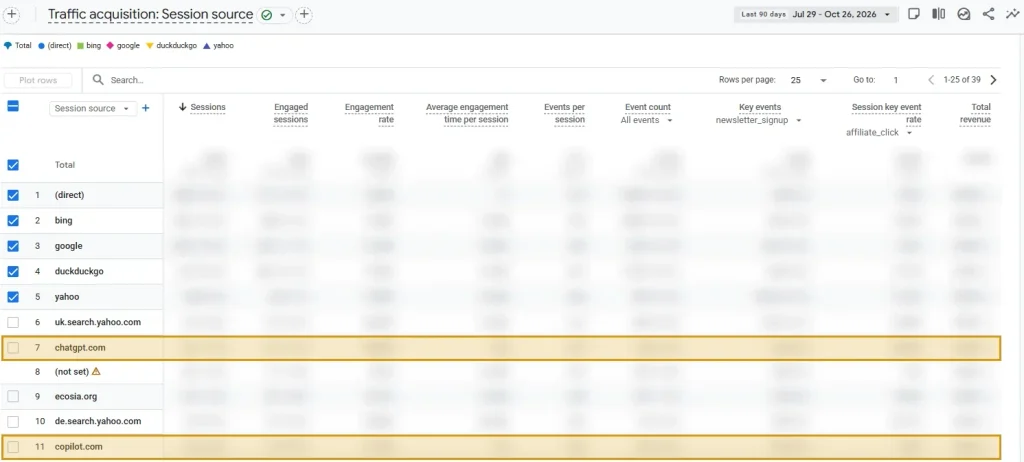
Before you change anything, find your starting point. In GA4, go to Reports → Acquisition → Traffic acquisition, switch the table to Session source and pick the last 90 days. Look for chatgpt.com, copilot.microsoft.com (or copilot.com), perplexity.ai, gemini.google.com and claude.ai.
Don’t stop at visits. Check what those visitors do: leads, purchases, sign-ups. A source with few visits but a high conversion rate is worth more than its share of traffic suggests.
Treat the result as a floor, not the full picture. Some visits from AI apps arrive without referrer information and are counted as direct traffic.
If you can’t see your leads by source at all, fix that first. Without reliable tracking, you can’t tell whether any channel works, AI or otherwise.
From our own site: RieuWorld
RieuWorld, our André Rieu fan site, earns from ticket partner links. Over the last 90 days (29 Jul to 26 Oct 2026), AI assistants sent about 2.5% of its visits. A small share, but visitors from ChatGPT clicked through to a ticket partner in about 21% of their sessions, against about 9% across the whole site. It’s an early signal, not proof, and it’s why we track this channel instead of ignoring it.
2. Ask the assistants what your buyers ask
Open ChatGPT, Copilot, Perplexity and Gemini. Ask the questions your customers ask before they buy, for example: “Which [your service] provider in [your city] should I use?”, “How much does [your product] cost?” or “[Your brand] or [competitor]?”
For each answer, note three things: whether you are mentioned, which sources are linked, and whether what is said about you is correct.
Repeat the same questions once a month. Answers vary from one try to the next, so look for patterns rather than judging a single reply. The linked sources show you where the assistant looks: review sites, directories, media articles, competitors’ guides. That is your target list.
3. Make sure AI assistants can reach your pages
An assistant can only cite what it can find and read. Three checks:
- Bing. Microsoft Copilot answers from Bing’s index, and other assistants also rely on search engines to find pages. Verify your site in Bing Webmaster Tools, submit your sitemap and check that your key pages are indexed. Many businesses set up Google Search Console and never do the same for Bing.
- robots.txt. Open yoursite.com/robots.txt. AI companies use named crawlers. OpenAI, for example, uses OAI-SearchBot to find pages for ChatGPT search and GPTBot to collect training data, and you can allow one while blocking the other. Some security plugins, hosting and CDN settings block AI crawlers by default, so check that you aren’t blocking the ones you want.
- Plain HTML. Many AI crawlers read the raw HTML and don’t run JavaScript the way Google does. If your prices, service descriptions or FAQs only appear after scripts load, they may be invisible. Quick check: right-click the page, choose View page source and search for a key sentence.

4. Put the answer in the first lines
Assistants pull passages that answer a question directly. A page that opens with three paragraphs about your history gives them nothing to quote.
On each important page, state who you help, what you do and the key fact (price range, area, timeline) in the first two or three sentences. Use headings that match the questions people actually ask, and keep one main topic per page.
An example: “We install home solar systems of 5 to 15 kW in Belgrade and Novi Sad, usually within four weeks of approval” is far easier to cite than “We bring the power of the sun to your home.”
Structured data (Organization, Product, FAQ, Article) helps machines read a page correctly. It doesn’t guarantee a citation, but it removes doubt about who you are and what the page covers.
5. Publish facts worth quoting
AI answers lean on specifics: numbers, dates, definitions, comparisons. Generic claims such as “industry-leading service” give an assistant nothing to repeat.
Give them something concrete: your own data with the period it covers, clear prices or price ranges, named sources for any third-party figures, and a visible “last updated” date. Original data is the hardest content to copy and the most likely to be cited.
Keep every figure true and checkable. An assistant that repeats a wrong number from your page spreads the mistake to every buyer who asks.
6. Be described the same way everywhere
Assistants build their picture of a business from many places: your website, Google Business Profile, LinkedIn, directories, review sites and media articles. When those sources disagree (old services, an old address, a different company name), the answer about you becomes vague or wrong.
Check that your name, what you do, your location and your main services read the same everywhere. Update or close old profiles. Then earn mentions on relevant media and industry sites, because those are exactly the sources assistants link to. This is where SEO and digital PR work together.
Frequently asked questions
Is AI search optimization different from SEO?
It builds on SEO rather than replacing it. Pages that are indexed, easy to crawl, clear and factual do well in both. The difference is emphasis: direct answers, quotable facts, consistent mentions beyond your own site, and measuring AI referrals separately.
Will AI assistants replace Google traffic?
Nobody knows yet, and anyone who claims to is guessing. Check your own data every quarter. On our own sites, search engines still send many times more visits than AI assistants do.
Should I block AI crawlers?
It depends on your content. Many businesses block training crawlers such as GPTBot but allow search crawlers such as OAI-SearchBot. That keeps the content out of future training data while still letting ChatGPT search find and cite it.
How quickly will I see results?
There is no honest fixed timeline. Fixes to access can count once your pages are crawled again. Being cited more often depends on your content and on mentions elsewhere, which takes longer. Measure monthly and judge the trend.
Where to start
AI assistants are a small but measurable channel, and they reward what makes a site good for buyers anyway: clear answers, real facts and a consistent presence. Start by measuring what you already get, then fix access, then improve your most important pages. To see how we approach organic growth, have a look at our SEO service. Questions about your own site? Contact us, we’re happy to help.